Sunday, February 19, 2012

NASA video and link to BoingBoing


The link in case you can't see the details of this video:

http://www.youtube.com/watch?v=Z6roMnYG-44


Also check out:
 Follow the Ice featured in Boingboing.com

Tuesday, August 9, 2011

Final Post

I guess four months is a long time to spend in a tent in the Arctic. When I got here in April, the sun went down for a few hours at night and everything was still frozen. In June the ice melted and everything turned green. The midnight sun came up for the solstice and then slowly went back down in late July. Now every night is getting a little darker and colder.

The science was more of a marathon than a sprint, although there were weeks in May and June when we were working constantly. July was fairly quiet. By then everything that was going to break had broken and most of the instrument quirks had been worked out, not to mention camp was set up and organized by then.

To measure the chemical and physical evolution of the Greenland Ice Sheet through the melt season, we had to consistently take the same measurements for months. Every day for most of the season we’d check the same instruments, download the same data, and hike to the same places.

Already, I can see evidence in my data of the changing glacial hydrology through the season. Just by looking at radon isotopes, I can tell that meltwater flowed very slowly in the beginning of the melt season traveling through tortured conduits in the ice. Then as the season progressed, flow channels opened up and melt increased making it easier for meltwater to move more efficiently to the ice sheet’s base and to its edges. We’ve also seen the chemical signature of several supraglacial lake drainage events. These events are important because they transport heat stored in surface meltwater to the ice sheet’s base resulting in more melt and faster glacial movement.

Overall, the fieldwork this summer was very physical. Often it felt like my PhD was in carrying heavy equipment around instead of chemical oceanography. My hands seemed to be always burning or numb with cold. I cut up and sewed a pair of socks into a pair of fingerless gloves that I wore most of July. Towards the end of June, there were occasional evenings when it was warm with just enough wind to keep the mosquitoes away but not so windy as to drive you crazy. On these nights, we’d bring our chairs out of the mess tent to eat, talk and read in the late-night sun. In July the mosquitoes were gone but cooler weather and heavy wind and rain kept us in tents for most meals though work was still outside.

When equipment was working properly we had downtime in camp. Without Internet, TV, phones, places to go or people to see, there were few distractions. Like it or not, life was simple. I spent my free time playing guitar and reading. Camp became a sort of book club. Everyone brought one or two books and so we read our books and then each other’s and talked about them over meals.

I’ll probably miss all this and I’ll definitely miss the people I met. Being immersed in nature and subjected to the elements reminds you that you’ve always got a choice. You can accept what’s going on or get upset wishing things were different. No matter how much you curse the cold and wind it’s going to stay cold and windy until it stops. Living outdoors reminds us where we came from and how tough we are. More importantly, I think living outside reminds us how important a sense of humor is. Everything is more fun and makes more sense when you laugh at yourself, everyone and everything.

That’s it folks. I pulled out of camp yesterday and today I’m sorting out my ‘kit’ in Kangerlussuaq. Tomorrow I catch a flight to Sisimiut, a coastal town 100 miles west of here. I'll camp and hike around there for six days and then catch a ferry to Nuke, Greenland’s capital city. I’ll spend a couple days hiking around there before flying to Iceland where I hope to (you guessed it) camp a few nights before finally flying back to the States on August 20, having spent 118 days away. Today I’m shipping my computer home and don’t plan to check email until I’m back in the States. If I see narwhals or walruses or have some sort of adventure worth sharing here, I’ll write it in my journal and post it here when I get home. But for now this is it!

Thank you to everyone who read my haphazard writing and thanks to everyone who wrote to me while I was away. It meant a lot to me to know that people were thinking of us. I’m looking forward to going home but for now I think I need just one more adventure.

Afoot and light-hearted, I take to the open road,
Healthy, free, the world before me,
The long brown path before me,
Leading wherever I choose.
     From “Song of the Open Road” by Walt Whitman

Tuesday, August 2, 2011

Update 7/23/2011

Summer seems to have ended. The wind has been blowing for two weeks straight and it’s cold enough to need long underwear and down jackets. Rain, wind and clouds are the new normal.

We’re learning all about katabatic winds. There is an almost constant high pressure system over the Greenland Ice sheet and when low pressure storms move up the coast, katabatic winds blow relentlessly from the high to low pressure systems. The sound of tents flapping is the new soundtrack of camp. We have to yell in the mess tent to be heard. Whoever is unfortunate enough to sit on the windward side has to put up with the tent collapsing down on them while eating dinner. It’s like someone is kicking the back of your chair and yelling while your trying to have a conversation.

Gone are the days when I’d play guitar in the mess tent after dinner. The wind makes it almost too stressful to read a book. Anything that isn’t in a latched container or held down by a rock has the potential to take flight and whiz through camp at approximately two thousand miles per hour. I have a newfound distain for plastic bags, blue plastic tarps and anything made of Styrofoam. Gusts of wind set these things to flight, rip them apart and take forever to track down and pick up the pieces. As we practice leave no trace camping, we’ve spent a lot of time hiking after wayward trash. Of course there’s the dust too. After a heavy day of wind, everything is covered in sand and grit. It flosses our teeth, coats our hair, and our clothes are hopelessly dirty.

I’m still taking cold bucket showers every other day but now I put on a parka the second I dry off. It seems that on any given day, the maximum wind speed and minimum temperature correlates perfectly to the moment I’m blindly reaching for a second bucket of water to rinse the shampoo from my eyes.

When there is a break in the wind, the world becomes tranquil and peaceful. Two days ago between back-to-back rain and wind storms, the world became completely still for an hour. The air smelled of fresh rain, the pond was so still it reflected the mountain above it, and the clouds and wet ground turned the lighting to a soft green. I spent the hour working outside feeling immensely at ease.

Update 7/13/2011

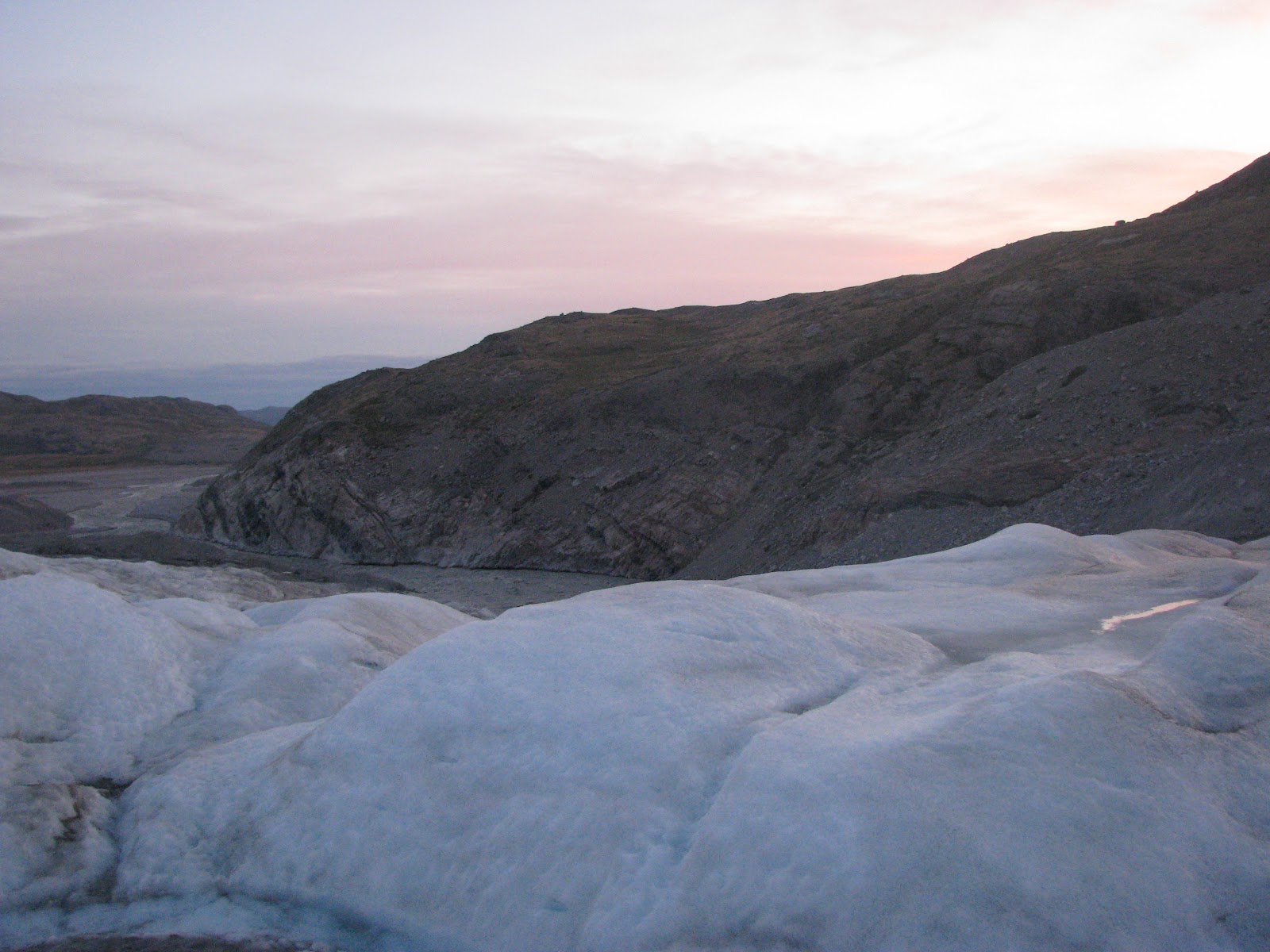
Our camp is on a peninsula of land sticking out into the Greenland Ice Sheet. Russell and Leverett glaciers are to the north and south of camp and the two rivers discharging these glaciers come together in the west. In short, ice and rivers surround us. As the melt season has progressed, the rivers have grown massive and our simple boat ferry made of climbing ropes and pulleys is no longer safe. Camp has suddenly become much more remote as access has been restricted to the weather dependent chartered helicopters.

Will Rosser, Alex Beaton, Liz Bagshaw set up
a newly designed nitrate probe on the ice.
We have a new crew in camp. Liz Bagshaw is a post doc in Jemma Wadham’s lab. A veteran of fieldwork in Antarctica, her stories include sleeping in a tent in Antarctica for months on end and having an infected wisdom tooth pulled by a Navy dentist who didn’t use anesthetic. She also met John McCain in Antartica and talked to him about what she was doing- filtering water. Ben Lishman is another post doc from the Wadham lab and is also new to our group. He’s an engineer with a quick sense of humor. While discussing on the best way to make the river crossing (a hovercraft is the group’s favorite), he claimed only two rules in life—never play cards with a man named after a city and never fly in a home-built helicopter.

Alex Beaton, after pulling a probe off 
the ice at midnight.
Will Rosser, our new undergraduate spent his first 24 hours in camp sampling the river every two hours and has already broken in his new alpine boots by jumping at every chance to hike on glacier. Alex Beaton, who got here in June, has extended his stay by two weeks in an attempt to fix a broken sensor. He’s working around the clock in a race to collect the data he’s spent a year preparing for. All and all, everyone is happy to do fieldwork and almost every night at dinner something is said which sends us into tear inducing fits of laughter. From the early season, Stuart Vinen and I are the only remnants from May and April.

Probably because of how long I’ve been here I’m suddenly somehow living in luxury. I’ve struck my small sleeping tent and moved into my large science tent. I’ve got a stove, a table, a chair, my guitar, and thanks to a care package from Dad, a cot with not one but two Therma Rests. I can make coffee before getting out of my extremely comfy bed and play guitar late into the night. If the wind didn’t regularly blow 50 mph all night and if it ever got dark, I’d probably be sleeping great!

Polar Bears!

A helicopter brought a rumor that somewhere between 10 and 100 miles away from my tent, a polar bear was seen and possibly shot (this last point was unclear). As if the wind and 24 hours of light didn’t make it hard enough to sleep.

Polar bears are extremely rare to this part of Greenland. The sea ice the bears hunt from doesn’t ever come this far south and East Greenland, where there are bears and ice, is a few hundred miles away across the ice sheet. But that doesn’t mean bears never come here.

Human encounters with polar bears are almost always deadly for the bear.

In 1997 a bear walked over the Greenland Ice Sheet from East Greenland (possibly through our current camp’s location) and ended up at a radio tower bunkhouse not three miles from my tent. Two men were working there when one sighted the polar bear. He ran into the bunkhouse and in a huge panic, started yelling about a bear. His buddy, probably used to pranks and jokes, laughed and refused to be duped into looking out the window. After a lot of hysterical yelling he did get up to look outside and made what I’m sure was a priceless facial expression. The polar bear was staring at him just outside through a thin pane of glass. The men called for help and the bear was promptly shot.

In 1957, a bear was seen outside of the town of Kangerlussuaq (about 10 miles as the crow flies from camp). Apparently very hungry, it approached a man working outside. The man didn’t have a gun and the bear charged. In some sort of heroic adrenaline packed moment, the man picked up a piece of rebar and smashed the bear over the head as it came at him. The big bear stumbled away, its skull was fractured and it was dying. The man ran home, got his rifle and put the bear out of its misery.

The skins of these bears are on display at the Kangerlussuaq museum along with the piece of rebar used to kill the 1957 bear.

While this daring seems extraordinary, for Greenland’s traditional hunters bravery is just another job requirement.

Here, men and women hunting from kayaks and (unbelievably) dogsleds throw harpoons by hand to kill seals, bears, walruses and whales. For thousands of years, Greenland’s dogsleds have been made twice as long as dogsleds in Alaska or Canada so that hunters can bridge gaps in broken sea ice. Without life jackets or any other sort of floatation device or safety precaution, dog sleds are driven onto the moving sea ice in the dark of winter. The hunters chase pods of narwhals, sometimes several thousand strong, and harpoon them as they breath through gaps in the ice. Men and women wearing polar bear pants pull whales out of the ocean with the help of their dogs.

The wild animals of Greenland are treated with great respect when killed and many Inuit traditions are still followed. Heads of animals are pointed towards the sea and given fresh water so that their spirits can find their way home and be reborn. From what I’ve read, overhunting has rarely if ever been a problem as communities do as they have always done—decide beforehand how many animals can be killed without hurting the population. Other Inuit practices such as not killing polar bears with cubs help ensure there will be enough animals to eat the next season. The fact that all the marine mammals surrounding Greenland have never been extirpated (except by commercial whaling by Europeans and Americans) is in itself a testament to the sustainability of the native hunters.

Incidentally, the main threat to the marine environment in Greenland and the traditional hunters comes from the rest of the world. Greenpeace and other environmental groups have convinced Europe and the U.S. to ban the trade of the skins or meat from sea mammals from Greenland. According to one of our books on Greenland, the price of furs is now so low that one can make more on government handouts being unemployed than by hunting. Adding insult to injury, the world’s air pollution rains out of the sky in the cold arctic air. Mercury, PCBs and DDT are found in alarming amounts in arctic marine mammals, and mercury has been found in horrifying quantities in the breast milk of Inuit mothers. These toxins build in concentration going up the food chain and as the Inuit are at the top of this chain, these people take in the worst of the pollution they are the least responsible for.

A great way to help is to simply use less electricity. Most of the mercury in the atmosphere comes from burring coal, which is how the vast majority of electricity is produced. So turning off the lights after leaving a room is actually something very real everyone can do to help kids in Greenland!
Monday, July 18, 2011

Summer arrives, new hobbies, and overnight sampling (Camp update: 7/7/2011)

[EDITOR'S NOTE: The river crossing connecting camp to town has been destroyed and the only way in or out at the moment is by helicopter. As a result, Ben has been unable to update the blog for several weeks and only recently managed to send this and the next several posts out with Catie Butler.]

In the past few weeks, Greenland has been green and the weather has been pretty much perfect in the 60’s (Note: 20 degrees or so for any Brits reading), sunny, a slight breeze, and cool nights. The legendary mosquitoes of the Arctic never materialized and we’ve had only a few days where you might say the bugs were bad. The hills and mountains are covered in willow, cotton grass, and wildflowers, and with a guidebook we’ve learned the names of all of them. If Eric the Red first saw Greenland in the summer, he may well have named this place Greenland in all honesty instead of as a clever ploy to lure more Norse to the cold island.

The camp uniform: mosquito protection
As of tomorrow I’ll have only one month left in camp. Despite the slow changing of the seasons, the summer has flown by. We can’t really divide the weeks up as we might at home, as each day is the same and the weekend is now meaningless. Every day, we have to take the same measurements, eat the same food, and hike to the same sampling sites. Occasionally someone will take a morning or afternoon off, but that seems to be about the extent of taking a break from work in camp. When gas injections are finished up on the ice sheet, river samples are taken every hour for days at a time. The night shift from midnight to 8:00 a.m. is split between two people who each have to wake up every other hour to take a sample.


Louise, Stu, Ben and Catie with our awesome homemade hats.
Two Hoods learns the guitar, while Catie shows off
her finished hat and ludicrously large bobble (later removed
as we decided it was a danger to passing aircraft).
As I can’t do anything like a normal person, I decided to try to gamble away all of my night shifts in a series of high stakes rock-paper-scissors games. After much laughing and trash-talking, I was convinced I would be able to beat the opposition and get a good night’s sleep, and the game actually ended up producing a much better sampling schedule for the overnight shift! The gods of rock-paper-scissors swung the game so that each person ended up taking equal numbers of samples but each got a solid, 3-hour nap at some point during the night. Perfect.

All-told, life in camp has been good. Trail running over the tundra is keeping me mostly sane and we are trying to teach each other new skills to keep busy. I have been trying to give guitar lessons, with mixed results. Catie has finished teaching me how to knit so I now have a completed beanie hat, which made Stu and Louise so jealous they made themselves hats, too. Along with our mosquito nets, wellington boots and bad tan lines, camp fashion is at an all-time high.

I’m reading a book about an American woman in the 90’s who spent seven years living in northern Greenland. In the book she describes how three things happen to those who come to Greenland for the long term: Your animal instincts come out, you go crazy, and you get happy. I think this is probably the best way to sum our life in camp.

Food, Drink, and Pranks (Camp update, 6/27/2011)

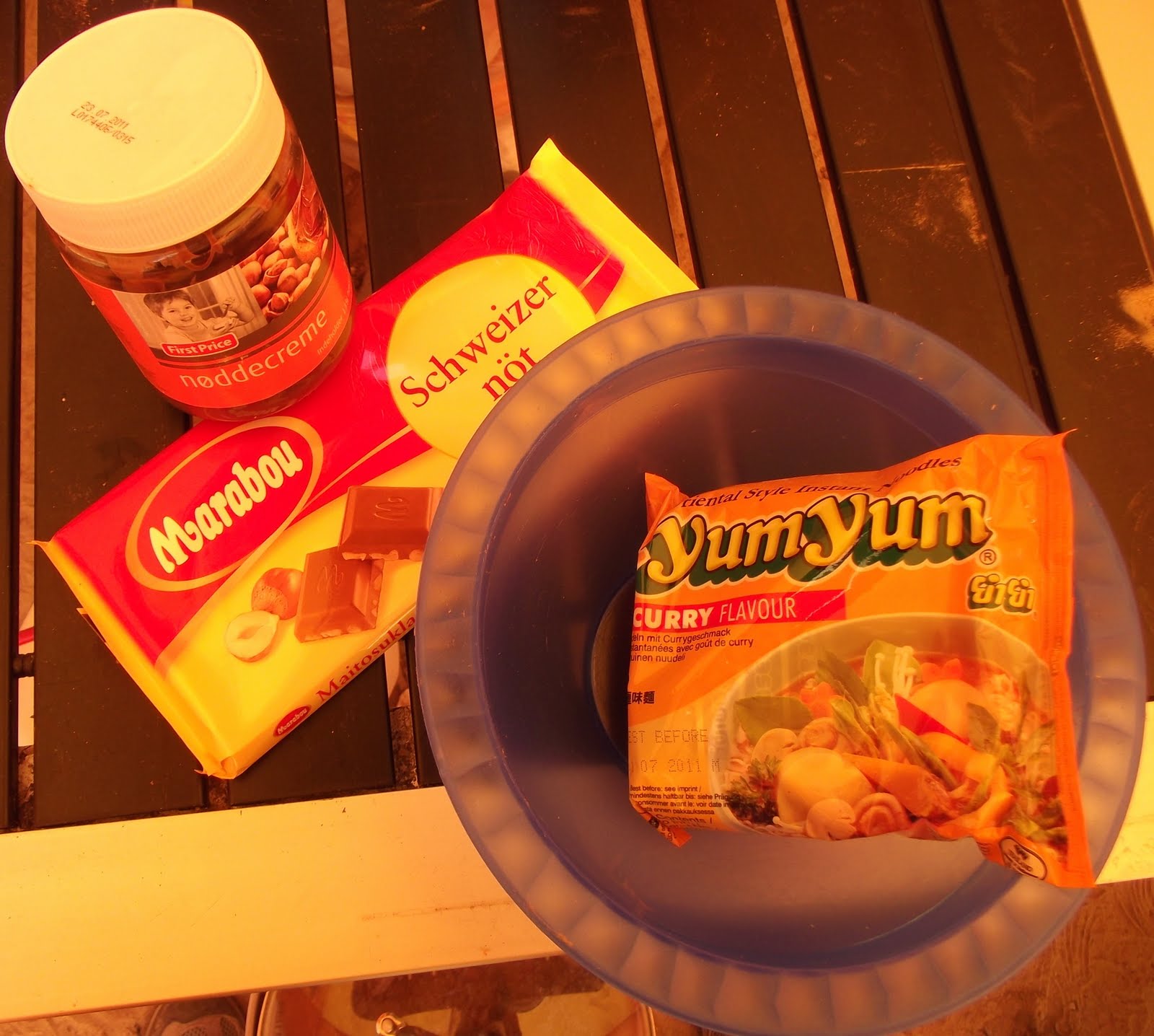
Two months have passed since we’ve arrived in Greenland and in another two months, I’ll be home. It’s been a few weeks since the sun has set and no one has seen darkness since we've been here. The constant light seems to affect everyone to varying degrees. Most of us sleep around five or six hours a night for a few days and then crash for twelve hours once a week. Going to bed here is like trying to sleep with all the lights on and I find it hard to feel tired when the sun is up. Midnight snacking on Raman noodles (well, the Danish alternative: Yum Yums) has become part of the camp routine, as everyone is usually still up and starving.
Taking a nap in the middle of the day--though we often work
at midnight. Our body clocks are really messed up.

On the solstice we had planned taking a midnight hike up to the ice sheet margin. Ironically, dense clouds and rain made the solstice an unusually dark night and so instead of a party we all went to bed early feeling exhausted.

Food is the most popular topic of conversation. After dinner there’s usually about an hour of reminiscing about the cheeses, fruits, vegetables, and fresh meats we miss. It is seemingly impossible to not talk about food; we’ve tried banning the subject, but after a few minutes of silence we give up and start at it again. Our meals are predictable. Porridge (oatmeal) for breakfast; bread and canned fish for lunch; and then instant mash potatoes, pasta, or rice with a can of corn and a can of bland meat for dinner. I put so much Tabasco sauce on everything that it’s become what I’ll probably associate with Greenland for the rest of my life. Dessert is hot chocolate, a chocolate bar, and sometimes a tin of peaches.
A typical, well-balanced meal of Noddecreme (chocolate spread),
hazelnut chocolate, and Yum Yum noodles.

The long awaited chocolate crate arrived in camp last week. It was packed to the brim with sweets, dried fruit and what the Brits call pudding and biscuits (I’ve tried to explain to them that biscuits are what you smother with gravy for breakfast and pudding is what Bill Cosby used to sell but no one listens). Anyways, the chocolate crate has been a big morale booster but is diminishing rapidly.

We drink unfiltered water directly from the lake next to our camp. There are MANY interesting little bugs that swim around in our water bottles like some sort of small portable aquarium. Little worms and fish-like larva are the biggest things but there are also little red beetles and water skimmers. The water tastes delicious, though, and combined with fresh bread from our bread maker are my two favorite things to eat and drink in camp.

Merciless teasing and prank plotting is the next most common topic of conversation. “You’re getting as big as an iceberg,” is a frequently used insult, with Catie’s Indian name officially now changed from Sleeps-Like-A-Tortoise to just Iceberg! The team is like a bunch of siblings and some days it seems like we laugh all day.

Musk ox or rock?
Catie and I spotted a herd of musk ox near camp one afternoon and crept to within a hundred yards of them before we were spotted and they ran away. After the musk ox ran off, we heard a deep growl coming from behind us. We turned and looked at each other in horror: “What was that!?” Spinning round, we saw Dave Chandler laughing behind a rock: he’d been stalking us while we stalked the musk ox.
Proof that a sleeping musk ox looks like a hairy rock.
Harold the musk ox wakes up, annoyed that we are
invading his personal space.

I now have to carefully check my towel for rhodamine powder before taking a wash. We use the powder to measure river discharge and even a small amount can temporarily turn the river bright pink. The pale gold powder, as it turns out, is really hard to see on a white towel and stains skin bright pink for days if you get any on you. At the moment, dying Stu’s light blonde hair pink has only been spoken about, but as we go slowly insane as the weeks progress we may stop being able to resist the temptation.